
Why do you need to create your estate plan? If you don't think you have an estate plan, you do—it's called Missouri's intestate laws. Missouri will divide your property. If you have no family, your property escheats to state ownership. Let's look at the reasons why you need to take charge of your estate plan and what the difference is between a last will and testament and a living trust.
Do You Really Need a Will?
A Last Will and Testament is your very last instructions you give to others. Your will is a plan that goes into effect at death. It is a basic estate plan that provides you with the final opportunity to make decisions about your property.
A Last Will and Testament is a public record in the Court System. The will is filed and admitted to Probate Court. When a will is filed, your final wishes and instructions are a permanent and searchable public record. You may be tempted to just let it be and die without a will. Probate without a will is a long, lengthy, and often expensive process. The probate file is a forever public file. Rather than your cherished belonging going to a favorite person, that long-lost cousin twice removed may suddenly show up and be the beneficiary.
Don't leave it to the state to decide. Be the boss of your estate plan.
What is a Revocable Living Trust?
A Revocable Living Trust is a tool you create to manage your assets during your life. It's revocable and amendable. Your trust owns assets while you still are the owner. You make the same decisions about your belongings as normal. It is a legal document, that sets out your beneficiaries at death. It also allows legal arrangements for what happens to your belongings if you become incapacitated. What are reasons to have a Trust? There are several reasons to create a revocable living trust. Let's review just a few.
The Privacy Issue
If you want to keep your wishes and instructions private, put your estate in a revocable living trust. A living trust has a will that catches assets you forgot to put into your trust. A living trust is NOT a public record filed and admitted to Court. The value of your estate and your assets is private. How you distribute your property is kept private. We are a country that values privacy. A Trust gives you that final act of privacy in life and death. If you forgot an asset-no problem, it is poured back into your trust, keeping it private.
Incapacity and Living Trusts
If a person becomes severally injured with a permanent brain injury or a Senior suffers from dementia, or there's an adult with mental incapacity, the trust protects and provides. A successor trustee can step into your shoes and make sure that person receives care and money from assets. It is a defense against financial exploitation.
Differences Between a Will and Trust
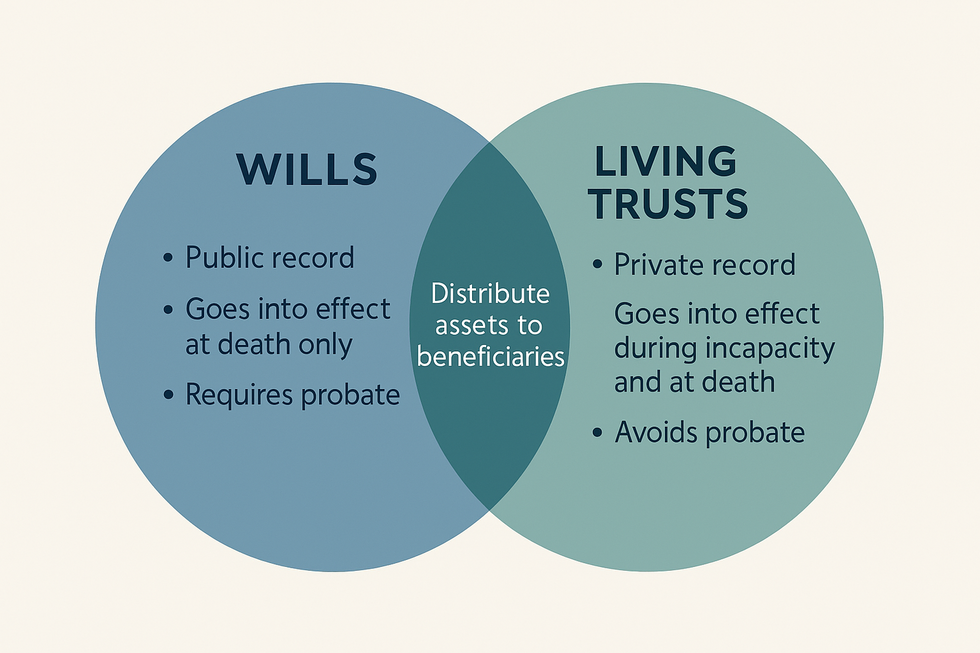
A last will and testament is a death plan—your last wishes and is a public record. To work with property that has no beneficiaries requires probate. Below are brief points for a last will and testament and living trusts
Wills
- Public Record after probate.
- Effective only at death.
- Requires probate (court process).
- Can name guardians for minor children.
- Simple and generally less expensive upfront.
- Probate process takes longer and may be more expensive.
- Personal Representatives must still be living.
- Beneficiaries must still be living to avoid complications.
Living Trusts
- Private document (not filed with court).
- Effective during life and after death.
- Avoids probate if properly funded.
- Provides incapacity planning (successor trustee can manage assets).
- Typically more expensive upfront, but saves time/cost later.
- Trusts contain contingency plans.
Your Estate Planning Attorney
It's essential to work with an estate planning attorney to create your estate plan. Don't settle for handwritten wills or a trust form. Don't put it off until it's too late. Your Estate Ally® is a boutique law firm that gives you personal care. Let Your Estate Ally guide you to peace of mind. Call Sheri Tucker at 314-332-0011 to book your complimentary consultation.
